
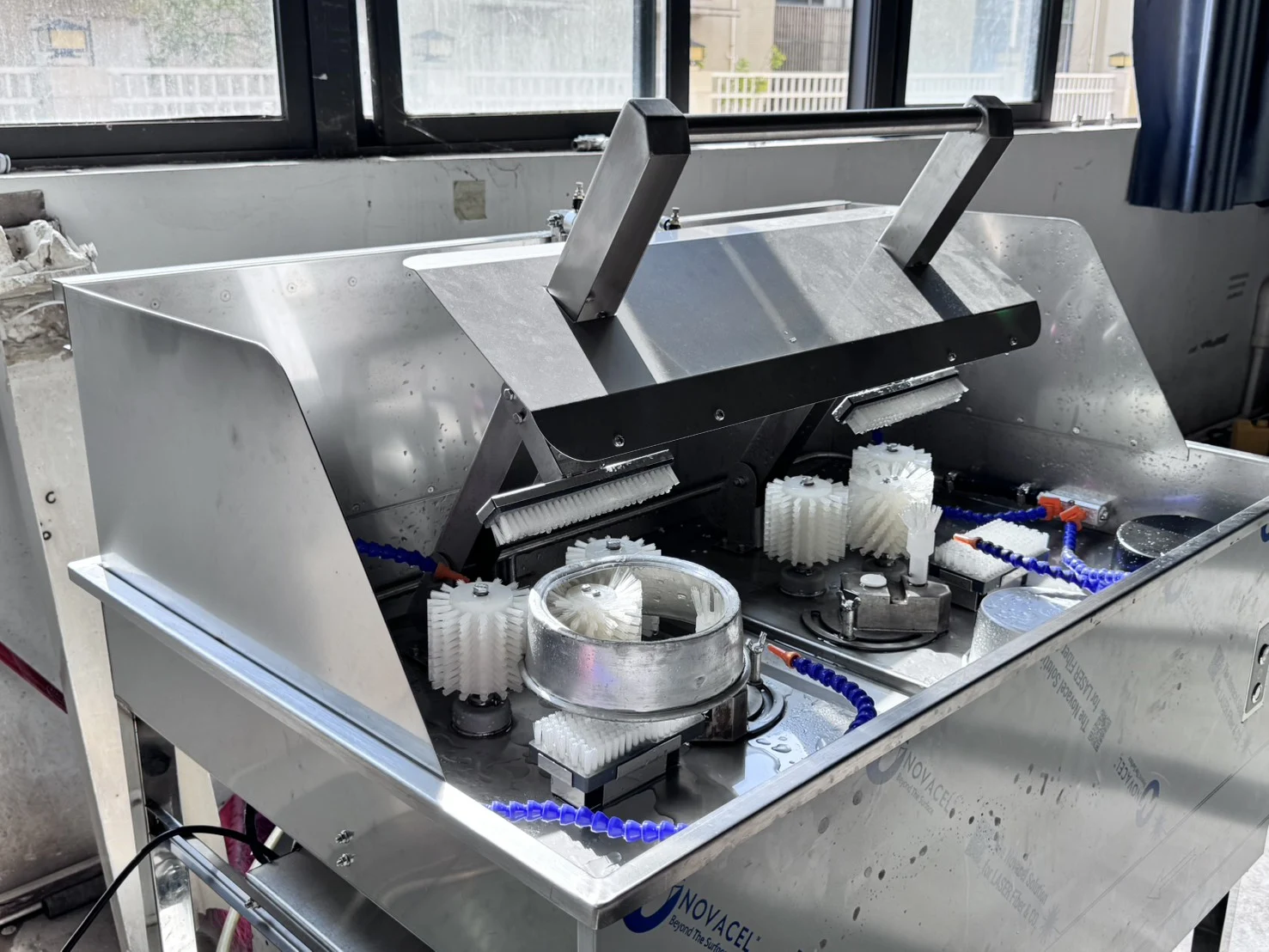
Specifications
| Station / overlap | Nominal diameter | What still needs checking |
|---|---|---|
| Right | 6–10″ / 152.4–254 mm | Positioning, height, rim and contact with the inner/outer brushes. |
| Left | 8–14″ / 203.2–355.6 mm | Base geometry, groove reach and surface condition. |
| Overlap | 8–10″ / 203.2–254 mm | Choose the position through sample evaluation, not diameter alone. |
1. Record geometry before sending a sample
Photograph the inside, outside, rim and underside with a scale in view. Record diameter, height, material, coating and how the base is attached. Include your smallest, largest and most frequent sizes, with coated and uncoated molds listed separately.
The published station ranges overlap at 8–10 inches. That does not mean both positions are equally suitable for every mold in that overlap. Brush contact and secure positioning still need confirmation.
2. Inspect the surfaces a diameter cannot describe
A cake ring, fixed-base pan and removable-base pan have different contact surfaces. The VT-CE-CM2 uses inner and outer roller brushes, plate brushes and an adjustable groove brush. A rolled edge or deep groove may alter where the bristles touch.
Ask V-TAI to confirm how each sample is positioned and whether a removable base is assessed separately. Do not assume an extra-deep mold, square pan or loose small part fits because one dimension is within range.
3. Agree on the coating inspection before washing
Identify the coating from the mold supplier where possible. Photograph an unused reference area and existing scratches under consistent lighting. Use a normally soiled sample and record wash settings, brush setup and the number of repeated cycles.
Compare residue removal and surface condition after the agreed trial. Record any scratching, peeling or exposed substrate. One successful wash does not establish coating life; no universal scratch-free claim is supported by the supplied documents.
4. Keep acceptance and sanitation separate
Accept the sample only when both cleaning and surface-condition criteria are met. If the result is uncertain, adjust the agreed trial with V-TAI or leave that mold outside the approved list. Keep the approved configuration with the sample record.
Cold-water brush cleaning is not heated sanitizing. Follow the facility’s separate hygiene, drying and storage process. The test record supports a defined mold and setup, not every coated item used in the bakery.
A FEW USEFUL ANSWERS
Are all non-stick cake molds compatible?
No universal compatibility is documented. Identify the coating and evaluate a representative sample.
Does one good wash prove the coating will last?
No. Record repeated cycles and acceptance criteria; coating lifetime needs separate evidence.
The short answer
Approve a named mold, coating and brush setup after a recorded trial; a diameter range is only the first filter.
Talk to an expertSources & product documentation
Based on V-TAI product information and the supplied product sheet. Final configuration and sample suitability should be confirmed with V-TAI.
V-TAI · VT-CE-CM2 ↗Download product sheet · PDF · Chinese · 2 pages ↗