
Specifications
| Metric | Value | Unit | Basis, formula & conditions |
|---|---|---|---|
| Quick cycle | ≈15 | s | Reference value Designer and product information; handling excluded. Product sheet · p. 2Reviewed |
| Molds per cycle | 2 | molds/cycle | Documented specification Designer and product information; handling excluded. Product sheet · p. 2Reviewed |
| Rated throughput | 300–400 | molds/h | Reference value Indicative throughput. Actual output depends on soil, mold size, cycle settings and loading time. Product sheet · p. 2Reviewed |
Written by V-TAI from its equipment designer’s application explanation supplied on 2026-09-09 and the product documentation. Two molds in 15 seconds and one operator attending 3–5 machines are manufacturer statements; 300–400 molds/h and utility specifications come from product documents. Arithmetic examples are planning calculations, not independent trials or customer case studies.
Download product sheet · PDF · Chinese · 2 pages ↗Why do removable-bottom chiffon cake rings still need hand scrubbing?
This guide concerns the separable wall of a removable-bottom cake mold and other confirmed compatible profiles. Buyers may search for chiffon pans, cake rings or loose-bottom cake tins. Those terms overlap, but a central-tube pan, unusual profile or separate base plate is not automatically compatible.
In the application described by V-TAI, cake residue adheres to the wall after steaming or baking and demolding. A brief rinse can remove loose crumbs while leaving persistent patches behind. Staff repeatedly scrub the same areas; when hundreds of rings return together, cleaning can delay the next production batch.
The mechanism: contact removes residue, water transports it
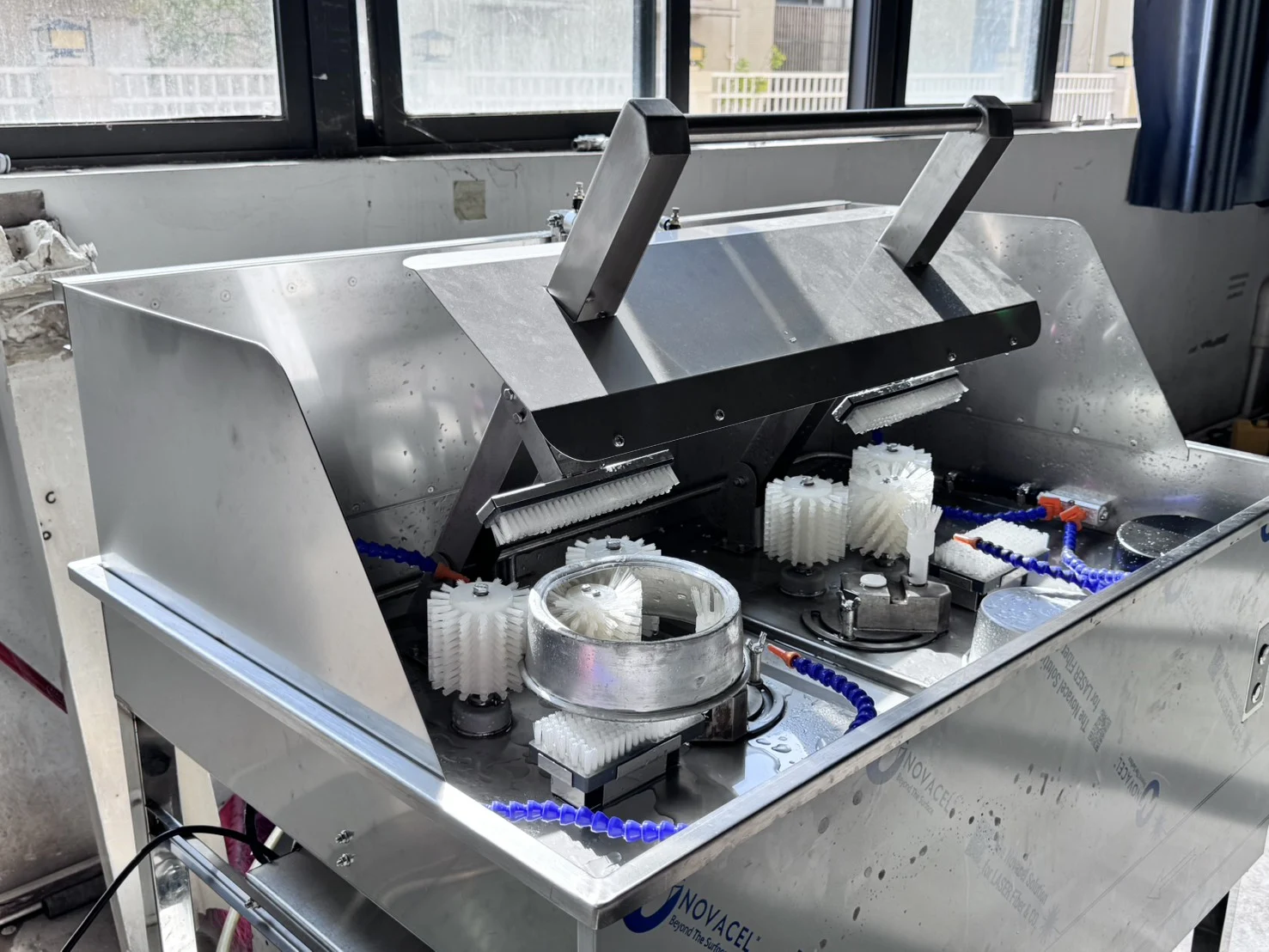
The VT-CE-CM2 transfers repeated manual brushing to mechanical contact between the mold and brush assemblies installed inside the machine. Assemblies are mounted and positioned for the mold profile, while the machine performs the automatic physical cleaning action. Fixed installation does not mean that the equipment has no moving parts.
Brush contact loosens and separates deposits in the areas it can reach. Cold-water flow or spray then carries detached soil away from the cleaning zone. Raising water pressure alone is not the same mechanism. Recesses, special bases and coatings still require a contact and compatibility check.
Two molds in about 15 seconds: why this is not a promise of 480 per hour
The designer’s explanation and product information describe a quick cycle of approximately 15 seconds for two compatible molds. The calculation 3600 ÷ 15 × 2 = 480 molds/h assumes no loading, unloading, checks, adjustments or interruptions. The separate published throughput reference is 300–400 molds/h; measure accepted output across the complete workflow.
For a batch of 120 rings, 60 dual-station cycles contain 15 minutes of washing alone. At the reference rate of 300–400 molds/h, planning time is 18–24 minutes. These are arithmetic examples, not test results, and do not validate your subsequent sanitation, drying or storage time. Tougher residue may require a longer cycle.
| Metric | Value | Unit | Basis, formula & conditions |
|---|---|---|---|
| Example batch quantity | 120 | molds | Planning example Planning arithmetic, not a measured production result. Calculation methodReviewed |
| Cycles for 120 molds | 60 | cycles | Calculated example 120 ÷ 2 = 60 Planning arithmetic, not a measured production result. Product sheet · p. 2Reviewed |
| Washing-only time for 120 molds | 15 | min | Calculated example 120 ÷ 2 × 15 ÷ 60 = 15 Washing time only; excludes handling, checks and interruptions. Product sheet · p. 2Reviewed |
| Planning time for 120 molds | 18–24 | min | Calculated example 120 ÷ 400 × 60 = 18; 120 ÷ 300 × 60 = 24 Planning arithmetic, not a measured production result. Product sheet · p. 2Reviewed |
| No-interruption arithmetic ceiling | 480 | molds/h | Calculated example 3600 ÷ 15 × 2 = 480 3600 ÷ 15 × 2; not measured output. Product sheet · p. 2Reviewed |
One operator attending 3–5 machines: the conditions matter
The designer describes one operator attending 3–5 machines under a suitable continuous-work arrangement. The opportunity is to load, unload or inspect at an adjacent machine while another brushes. Each unit remains the same VT-CE-CM2 model; this is an attended workflow, not a claim of autonomous operation.
It depends on consistent mold sizes, short travel distances, separated dirty and clean areas, efficient handling, trained operators and adequate utilities. Time waiting and walking during an on-site trial. Do not multiply the single-machine reference by the number of units and present it as guaranteed output per person. Load, unload and adjust only after the machine stops completely.
| Metric | Value | Unit | Basis, formula & conditions |
|---|---|---|---|
| Operators in this arrangement | 1 | operators | Conditional arrangement Conditional designer statement; verify on site. Designer explanationReviewed |
| Machines attended per operator | 3–5 | machines/operator | Conditional arrangement Conditional designer statement; verify on site. Designer explanationReviewed |
Where is it worth evaluating, and which molds need a sample check?
Cake factories, bakery-chain central kitchens and centralized pastry production with repeated batches of removable-bottom rings are useful starting points. The deciding factors are time spent hand scrubbing the same residue and the number of clean rings needed back at peak production. Small or frequently changing batches may spend more time on setup and movement.
Documentation lists right-station diameters of 6–10 inches, left-station diameters of 8–14 inches, 0.5 kW total power and cold-water cleaning. These figures do not establish compatibility with every height, material, coating, wall profile or base design. Confirm whether the base plate must be removed and cleaned separately and whether brushes can reach a tube-pan profile.
| Metric | Value | Unit | Basis, formula & conditions |
|---|---|---|---|
| Mold diameter / right station | 6–10 | in | Documented specification Confirm material, coating, height and profile with our team. Sample testing is recommended for delicate coatings and unusual shapes. Product sheet · p. 2Reviewed |
| Mold diameter / left station | 8–14 | in | Documented specification Confirm material, coating, height and profile with our team. Sample testing is recommended for delicate coatings and unusual shapes. Product sheet · p. 2Reviewed |
| Total electrical load | 0.5 | kW | Documented specification Electrical power rating, not measured energy consumption. Product sheet · p. 2Reviewed |
Validate a complete shift workflow, not just an attractive demonstration
Bring dirty molds representing normal and difficult conditions. Record steaming or baking process, time since demolding, residue location, dimensions and material. Compare the existing hand-cleaning process with the machine on comparable samples, timing from initial handling to the same acceptance check. Count each accepted ring only once, including rewash time in the total.
Check the inside wall, seams and lower groove for residue, scratches and coating changes. Record accepted quantity, total elapsed time, staffing, rewashes and measured water use. Only a comparable baseline supports a reproducible labor-saving calculation. Cold-water brushing removes residue; it is not a heated sanitizing process. Follow your separate hygiene procedure.
Turn a cleaning problem into a testable equipment decision
Before selection, send inside and outside photos, close-ups of the hardest deposits, base-removal details, diameter, height and peak return volumes. Ask the trial to establish both whether brushes reach the problem areas and whether the complete cleaning station sustains the required accepted output.
This dedicated V-TAI machine combines deposit removal, cold-water transport and two-station operation. Its practical benefit is less repetitive hand scrubbing and a more organized cleaning workflow. Suitability should be established with your dirty molds, acceptance standard and site layout.
A FEW USEFUL ANSWERS
How do you remove residue that water will not rinse off a chiffon pan?
Check the mold profile and residue first. Compatible mechanical brushes can loosen adhered deposits while cold water carries them away. Confirm coverage and the result using dirty production samples.
Will 15 seconds clean every cake mold?
No. About 15 seconds for two molds describes the quick cycle. Thick or dried deposits may need longer brushing, adjustment or another pass.
Does one operator on five machines guarantee 2,000 molds per hour?
No. Handling, inspection, travel, interruptions and rewashing share the same operator’s time. Measure accepted total output from the actual multi-machine workflow.
Can separate bases and central-tube chiffon pans go straight into the machine?
Confirm dimensions, profile, coating and brush contact first. The name chiffon pan alone does not establish compatibility.
The short answer
If repeated hand scrubbing of cake-ring residue is your bottleneck, test brush contact and cold-water removal first, then verify staffing and output across the complete workflow.
Talk to an expertSources & product documentation
Written by V-TAI from its equipment designer’s application explanation supplied on 2026-09-09 and the product documentation. Two molds in 15 seconds and one operator attending 3–5 machines are manufacturer statements; 300–400 molds/h and utility specifications come from product documents. Arithmetic examples are planning calculations, not independent trials or customer case studies.
V-TAI · VT-CE-CM2 ↗Download product sheet · PDF · Chinese · 2 pages ↗