
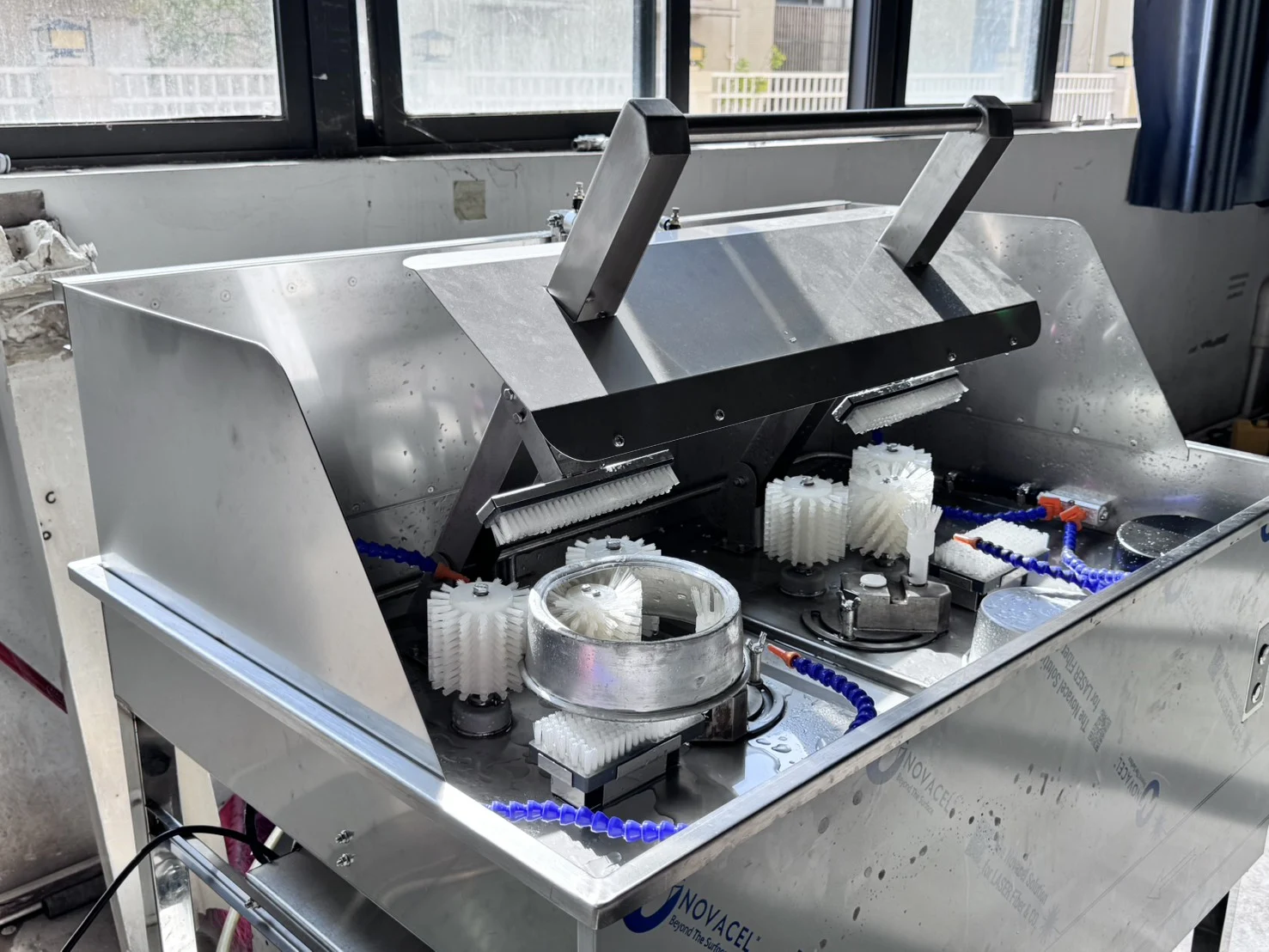
VT-CE-CM2: the documented numbers
| Dimensions (L × W × H) | 1200 × 740 × 1215 mm |
|---|---|
| Mold diameter / right station | 6–10″ |
| Mold diameter / left station | 8–14″ |
| Rated throughput | 300–400 molds per hour |
| Total electrical load | 0.5 kW |
| Motors | 0.2 kW × 2 |
| Water inlet / drain | 3/4″ / Ø38 mm |
Three useful planning calculations
Machine footprint
1.200 × 0.740 = 0.888 m²
Cabinet footprint only; add loading, drainage and maintenance clearance.
600 molds at the stated throughput
600 ÷ (300–400) × 60 = 90–120 min
90–120 minutes is an arithmetic range at a steady 300–400 molds/hour, not a measured completion time.
600 molds within a 3-hour window
600 ÷ 3 = 200 / h
Your complete workflow must average at least 200 accepted molds/hour. Include handling and checks.
These are calculations from published specifications, not independent tests. Water consumption, measured electricity use and labor savings are not quantified here because no supporting test protocol or results were supplied.
1. Start with the mold, not the hourly capacity
A diameter range is the first fit check, but it does not describe the whole mold. Height, base construction, a rolled rim and a recessed bottom groove can change how a brush contacts the surface. Send photos of the inside, outside and underside alongside dimensions.
The VT-CE-CM2 has two different station ranges within the same machine: 6–10 inches on the right and 8–14 inches on the left. These are workstations, not separate models. Cake rings, fixed-base molds and removable-base molds should be assessed against their actual geometry.
- Record your smallest, largest and most frequently used molds.
- Separate coated molds from uncoated ones in the sample list.
- Include a normally soiled sample, not only an unused mold.
2. Match the cleaning method to the residue
The VT-CE-CM2 combines inner and outer roller brushes, plate brushes, an adjustable groove brush and directed water spray. Brushing loosens residue while the water carries it away. This is a dedicated mold-cleaning process, rather than a claim that every item in a bakery will fit.
Use your actual cake, grease or cream residue when evaluating results. A longer wash setting may be needed for some loads. Agree on which surfaces must be checked after washing, including the base groove and the rim, so the sample review has a clear standard.
3. Separate wash time from real production throughput
The product sheet gives an indicative 300–400 molds per hour. The approximately 15-second quick cycle refers to the washing of two molds; it does not include all loading, unloading, adjustment or inspection time. Do not divide an hour by 15 seconds and treat the result as guaranteed output.
Plan around the time your operation actually has. For example, 600 molds within a three-hour cleaning window require an average of 200 molds per hour across the complete workflow. This is a planning calculation, not a machine test result. Check whether handling, breaks and changes between sizes fit that window.
For a useful demonstration, count clean, acceptable molds over a representative run. Record operators, mold size, residue and cycle settings with the result. This makes the comparison more useful than a short video of the fastest cycle.
4. Check services before choosing the location
The published external dimensions are 1200 × 740 × 1215 mm. The machine uses 380 V three-phase power, has 0.5 kW total electrical load and two 0.2 kW motors. Low power does not mean it can be plugged into an ordinary single-phase outlet. Confirm the 50/60 Hz configuration for your site.
Plan for a 3/4-inch water inlet and Ø38 mm drain, together with space for loading, unloading and service access. The supplied manual also references compressed air. Have V-TAI confirm the requirement for the machine being delivered; do not infer a pressure specification from an unclear unit in an older document. A qualified professional should install the electrical connection.
5. Treat coating suitability and sanitation as separate checks
The material and coating determine whether a mold is suitable for brush contact. Do not assume that all non-stick finishes behave the same way. Ask for a sample evaluation and agree on an inspection method for the cleaned surface.
Cold-water washing removes residue through mechanical brushing and rinsing. The VT-CE-CM2 does not provide a heated sanitizing cycle. Keep the separate sanitation process required by your bakery, and follow the supplied operating and maintenance instructions.
6. Request a quotation with evidence, not just a model name
A useful inquiry combines the mold sample list, daily volume, busiest-hour demand, installation location and delivery destination. Ask the supplier to confirm the station fit, settings, site services, included items and delivery terms in writing.
This guide is based on V-TAI product documentation and the supplied product sheet; it is not a report of an independent performance test. The aim is to turn your cleaning requirement into a clear equipment specification before you order.
- Confirm your molds with photos, dimensions and samples.
- Evaluate accepted output across the full working cycle.
- Check coating compatibility and the separate sanitation plan.
- Confirm electrical, water, drain and any compressed-air requirements.
Quick answers for equipment buyers
Which molds can it clean?
The right station supports 6–10 inch diameters; the left supports 8–14 inches. Send dimensions and photos of your rings or molds to confirm fit and brush contact.
Is 300–400 molds per hour guaranteed?
This is indicative capacity. Output depends on residue, cycle duration, dimensions and handling. The approximately 15-second quick cycle excludes loading and unloading.
Can it clean non-stick molds?
Coatings and materials differ. Send mold details or a sample for evaluation before brush cleaning coated or delicate molds.
The short answer
The right washer is the one proven suitable for your molds and your complete workflow. Start with a sample and a clear cleaning target.
Talk to an expertSources & product documentation
Based on V-TAI product information and the supplied product sheet. Final configuration and sample suitability should be confirmed with V-TAI.
V-TAI · CE-CM2Download product sheet (PDF · Chinese · 2 pages)